One runtime, several ways in.
I extended Pi’s open-source foundation with Kora’s tools, skills, personal context, and product services. The interfaces share behavior rather than each implementing a separate assistant.
A personal AI assistant with a place for your context, tools, and work.
Explore the real Kora interface: conversations, projects, calendar, memory, and Life. The workspace is filled with fictional test data.
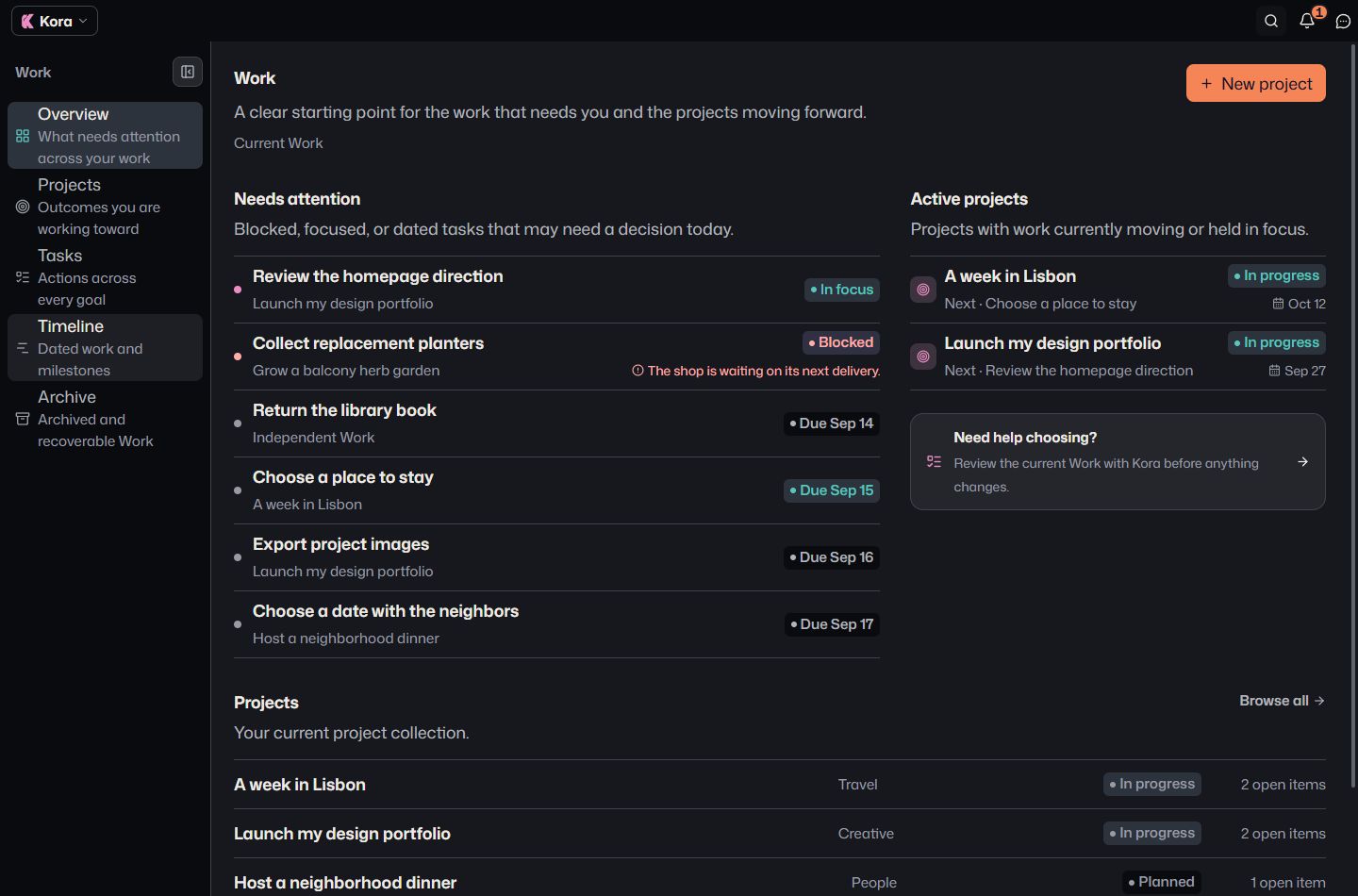
Uses fictional data. No account needed.
This is Kora’s actual public application UI, running with fictional local data. Explore every workspace; live AI and connected services require the installed app.
Open in a full window ↗The useful part is continuity: knowing what you are working on, finding the relevant context, and keeping the result somewhere you can use it again.
Kora brings conversations, personal knowledge, and structured work into a Windows application. A shared runtime connects the desktop interface, CLI, and Chrome extension, with durable state in SQLite.
I extended Pi’s open-source foundation with Kora’s tools, skills, personal context, and product services. The interfaces share behavior rather than each implementing a separate assistant.
Persistent records and hybrid retrieval connect the assistant to personal knowledge and work. Keeping state locally makes it inspectable; model requests still use the configured provider.
Durable sessions and stored artifacts give the assistant a way to pick up existing work instead of starting every interaction from scratch.
Interfaces for the same assistant
Pi foundation · tools & skills · context · sessions
SQLite · personal knowledge · files · permitted actions
What happens when a plan changes halfway through the week?
I built an evaluation harness with simulated-user interactions, controlled event timing, changing workweek scenarios, and blinded review. It examines task completion, memory persistence, authorization boundaries, and recovery across restarts.
This is ongoing evaluation work. The interactive sample above demonstrates the interface; it does not run this evaluation or make a live agent request.
Kora is in active development. The public repository contains the Windows app, runtime, and setup instructions, including its Pi-derived foundation and license notices.
Explore the repository